
Particle or gel-control screening
Provide the resin and solvent family, viscosity, defect mode, dispense position, flow and allowable pressure drop before comparing membrane options.
HDPE, nylon and PTFE membrane options for initial screening in photoresist, bottom anti-reflective coating (BARC), TMAH developer, compatible solvent and DIW filtration positions.
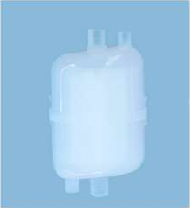
The LTD1 format combines a PP housing, end caps and cage with HDPE support and an NPT connection. The membrane option is selected separately: HDPE, nylon or PTFE.
Photoresist, BARC, developer, solvent and DIW are application directions—not a statement that every membrane suits every formulation.
For TMAH, confirm concentration and temperature, membrane material, extractables or precipitation concerns, wetting behaviour, equipment conditions and the qualification method.
Review the available configurations and operating limits below, then confirm the selected membrane against the application.
| Item | Published value |
|---|---|
| Application direction | Photoresist, BARC, TMAH developer, related solvents and DIW filtration |
| HDPE membrane options | 50 / 30 / 10 / 5 / 2 / 1 nm · 0.24 m² |
| Nylon membrane options | 50 / 20 / 10 / 5 nm · 0.18 m² |
| PTFE membrane options | 0.45 / 0.2 / 0.1 µm and 50 / 30 / 20 / 10 nm · 0.24 m² |
| Structure | PP housing, end caps and cage · HDPE support |
| Connection | NPT |
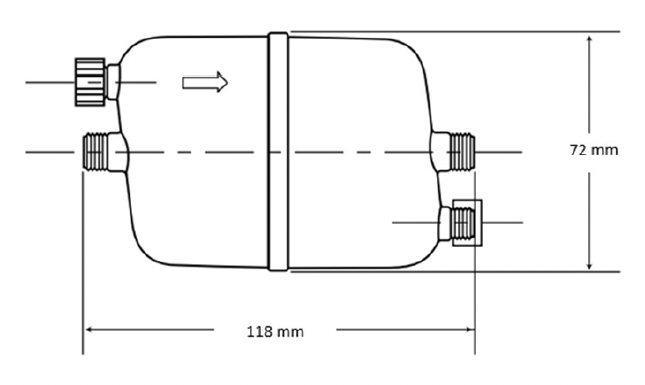
| Drawing dimensions | 118 × 72 mm |
| Maximum pressure | 0.39 MPa at 24°C |
| Maximum application temperature | 24°C |
| Maximum forward differential pressure | 0.28 MPa at 24°C |
Confirm the membrane, chemical compatibility, wetting requirements and operating conditions for the selected configuration.
A labelled grade does not replace a documented compatibility and qualification plan.
Provide the resin and solvent family, viscosity, defect mode, dispense position, flow and allowable pressure drop before comparing membrane options.
Confirm TMAH concentration, temperature, contact time, membrane compatibility, extractables or precipitation risk, wetting and the equipment envelope.
Identify the chemical or SDS, temperature, pressure, flow, NPT interface and cleanliness target. The application label alone is not an approval.
The supplied drawing shows 118 mm × 72 mm. Confirm the actual connection, tubing layout, bracket and service clearance before release.
No blanket compatibility statement is made. Confirm TMAH concentration and temperature, membrane material, extractables, wetting behaviour, equipment conditions and the planned qualification method.
No. The listed grades identify available configurations and do not by themselves establish absolute retention performance. Confirm the test method and validation data for the selected configuration.
Send the chemical or SDS, concentration, temperature, flow, allowable pressure drop, process position, NPT interface, equipment envelope and the particle, gel, extractables or wetting qualification target.
Send the formulation or SDS, operating conditions, interface and validation target.